Showing posts with label bees. Show all posts

Monday, 2 May 2011

May Day Lasagne Party

The hands, minds and muscle of GTUF came to the rescue on Sunday, celebrating a rare spring-like day of sunshine and offering some labour for Labour Day. They arrived ready to transform cardboard, newspaper, straw, llama manure, grass clippings, seaweed and leaf mulch into garden beds which will yield fruit for passing pedestrians.

We started with the boulevard. First you use your lawn edger to score a trench around the edge of the bed.


Line the trench with newspaper: hose it down.


Then apply the cardboard, which keeps the weeds from rising up through the soil. Hose that down too.


Line the trench with straw, and then cover the cardboard with llama manure.


Top with more straw


and whatever else is on hand: grass cuttings, seaweed, leaf mulch.


Plant raspberries, plants dipped in a little EM, watered in well, and bedded in enriched soil:


Time to move up a level to the corner of the lawn. Edges dug, lined with newspaper.


More cardboard on top of the newspaper.


Straw and manure, followed by grass clippings and seaweed and leaf mulch...


and all ready for rhubarb.


Preparing the planting hole for rhubarb, which roots deeply: cut an X in the cardboard to allow the roots to penetrate


place the plant and water really, really well (fill the hole with water)


and then surround with a nice blanket of good soil.


Moved along the wall to make another bed, for strawberries.


Cardboard, straw, llama manure..


..water well to prepare for planting.


Strawberries all planted. Shallow rooted, so they don't need to be bedded in like the rhubarb.


Water them in.


The long view: three beds in just under three hours. Thank you all!


Everyone happy... with the possible exception of some ground-dwelling bees who may have been displaced in the process.

Thursday, 7 April 2011

Spring things

The blue orchard bees are starting to emerge, a little late due to the chill. Lots of blossom for them to snack on, I hope.


After a talk about bees I started leaving my dandelions to flower as they are apparently a valuable nectar source early in the season.


Slug eggs found and destroyed:


Asparagus!!!


Got my tomatoes seeded last month and now they're starting to pick up speed. Many varieties on the go.

Black Krim:


Persimmon tomato:


A sweet roma I enjoyed in last summer's veg basket from Haliburton:


San Marzano:


Another from Hali, a potato leaf variety, the Japanese Black Trifele:


and a somewhat rare Bearo Plum

Monday, 7 March 2011

GTUF goes to the bees

Yesterday the Gorge Tillicum Urban Farmers had a very well attended and lively session


on wild pollinators from Gord Hutchings


who talked about the range of pollinators available to gardens in BC. His ire had been raised by too much talk on the part of honeybeekeepers about the threat to food production created by hive losses, when in fact there are something like 800 different species of wild bees - as well as many other butterflies, flies and other insects and birds who act to pollinate plants.

This is not to say that wild pollinators are not at risk; they face serious problems from loss of habitat; pesticide use; large scale agriculture and monocropping which create fields too large for natural pollination; and loss of food sources through the replacement of native plant species with imported and hybridized or genetically modified plants. Because so many of our native bees are ground-dwelling, our fondness for pavement, pristine weed-free gardens, and digging over of soil are harming the long-term health of our gardens.

Afterwards there was time to look at the display items


which included some variations on bee houses; the one on the left is a mason (Blue Orchard/ Osmia lignaria) bee condo, the one on the right a bumblebee box. Bumblebees are our only native social bee: the rest are solitary. They are at risk from the same factors affecting all wild bees, and also from the large number of bumblebees brought in to service the greenhouse industry. Some of them find their way out of the greenhouses and pass diseases on to the native varieties through pollination activity.


The orchard mason bee condos are designed to allow the bee pupae to be removed and cleaned over the winter, to rid them of mites and ready them to emerge in the spring. Here is the device used to clean the cocoons (with sand):


and here are some cleaned mason bee cocoons:


(the black specks are larval excreta rather than mites which will appear lighter in colour).

And here are some interested GTUFers:

Wednesday, 26 May 2010

More crawlies

It is very much tent caterpillar season. Here is one with the mark of satan on its brow: a parasitic (ichneumon?) wasp has laid its egg on this unfortunate. There's a moral choice here: kill the caterpillar for a swift death, and wipe out a beneficial insect? Or leave the caterpillar to experience an Alien-type of death? Nature can be a difficult place.


Spring is also a time of digging in the garden, and I had an interested bystander last week who watched me carefully to make sure I had not uprooted the rock that was its home.


I decided to extend a little patch of garden by digging a couple of feet into the lawn


which meant digging up some grass and, in the process, a large population of wireworms


as well as a large population of leatherjackets, a couple of snails


and a cutworm larva.


My war against slugs continues, and I think I'm getting the upper hand, mostly by hand-picking at night. But I complement this activity with some slug traps made out of used styrofoam or plastic cups,


baited with home brew (water, yeast, sugar and flour) and it attracts a good number of drinkers who hang out in the bar past closing and then fall in.


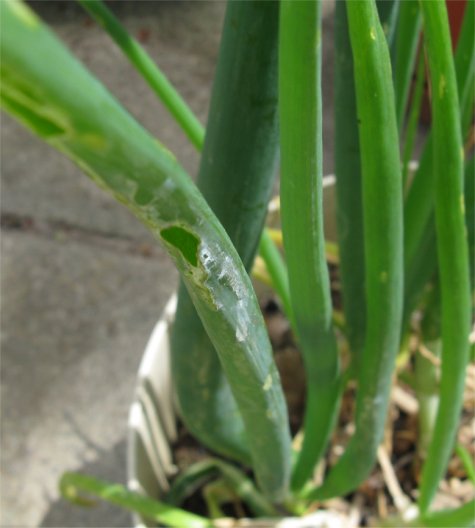
I have been surprised by my slug populations' fondness for onions.


The chives are in full blossom, which is good for my salads and visiting bees:


The garden spiders have moved to the strawberry pots:


My overwintered artichoke has offered a second bulb and seems perfectly happy under the downspout of the garden shed, surprisingly. Plagued with ants though, and I'm not sure if that's harmful or not. More research needed.


The potato car tire experiment continues, behind the shed, next to the fence, so well out of direct sunlight. They seem happy enough so far, as do the burlap bag specimens.


The leeks are looking better in the pot than they do in the garden (where I suspect wireworms have been nibbling on their feet), and the radishes are helping to pass the time between them:


Lots of flowers on the fava beans: